Carson-Newman commencement celebrates Class of 2026, Robert Reedy Bryan Society inductees
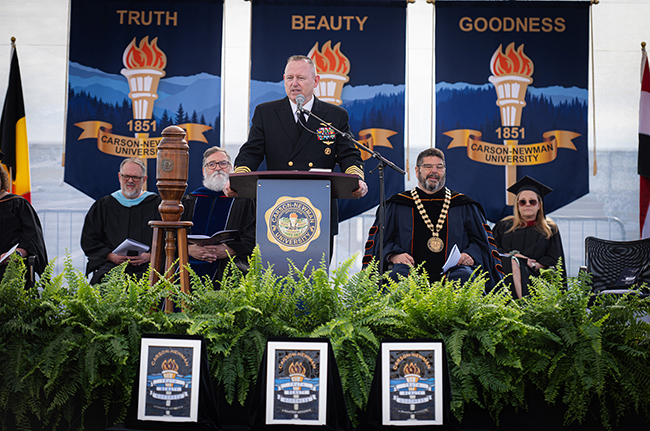
Retired NASA Astronaut and U.S. Navy Captain Butch Wilmore addresses students during Carson-Newman University’s Spring Commencement.
Carson-Newman University held its Spring Commencement Ceremony on Friday, May 1. During the event the University inducted five new members into the Robert Reedy Bryan Society, as well as celebrating the accomplishments of the Class of 2026.
A total of 218 undergraduate degrees were conferred, as the graduates were addressed by keynote speaker and retired NASA astronaut Barry “Butch” Wilmore. The Tennessee native was selected by NASA as an astronaut in 2000. He is a veteran of three spaceflights and accumulated a total of 464 days in space before retiring in July 2025. Friday’s undergraduate and graduate ceremonies celebrate Carson-Newman graduates representing 30 states and 18 countries.
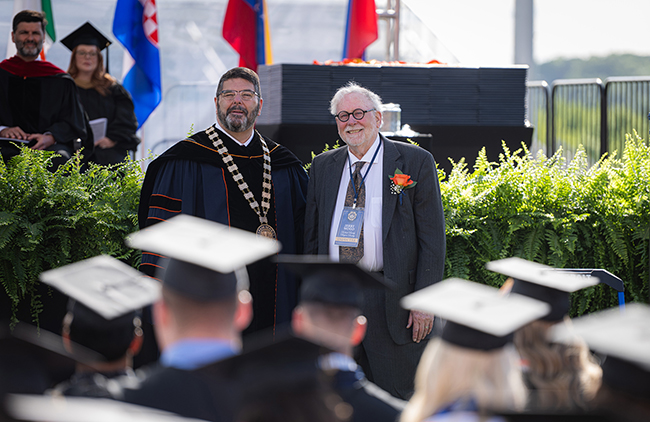
Carson-Newman University inducted the fifth class of the Robert Reedy Bryan Fellows during its Spring Commencement. Pictured is C-N President Charles A. Fowler (left) congratulating inductee Dr. Gerald Wood.
Those inducted into the fifth class of the Robert Reedy Bryan Society were Dr. William and Carolyn Blevins, Ted and Drama Russell, and Dr. Gerald Wood. Named after the University’s second and sixth president, the society honors the dedicated and selfless service of retired faculty, staff and others whose service to the University is exceptional and meritorious.
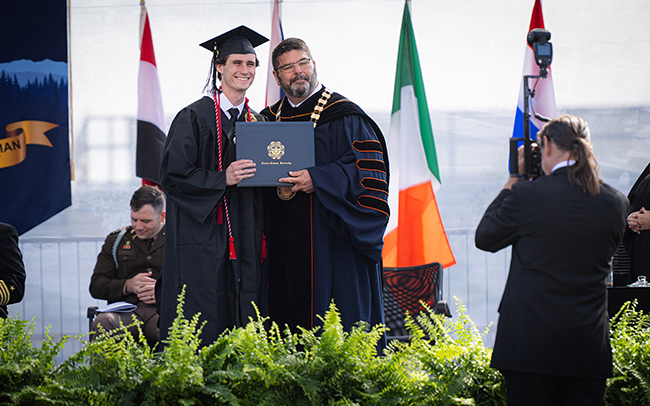
Adam Reller of Dandridge receives his degree from University President Charles A. Fowler.
Dr. William and Carolyn Blevins
Bill and Carolyn met as freshmen at Carson-Newman. They graduated in 1959, marrying one month later. With life-odysseys converged, they both pursued seminary degrees, after which life brought them back to Mossy Creek and the beginning of careers that would touch countless lives over the course of more than 70 years of combined service. Bill joined the faculty in, what was then, the Religion Department. Carolyn joined the department a few years later. Bill, who also had a background in psychology, began a part-time program through the department to offer counseling to ministers and their families. Carolyn poured herself into C-N’s Honors Program and efforts to support young women interested in ministry opportunities. Upon Bill’s retirement, and in recognition of his many contributions to the area of counseling, C-N established the “William Blevins Institute for Spirituality and Mental Health.” Both credit C-N for empowering them to pursue their passions while making a difference in the lives of students.
Ted and Drama Russell
There’s nothing wrong with Ted Russell’s vision. The octogenarian has always had a knack for seeing the potential in things. His love for automobiles came early in his life, as did his ideas of “what could be.” He realized for him to grow in the car business, he needed an education. He enrolled at Carson-Newman, graduating in 1962. His education coupled with his natural drive led him into a successful career in the automotive business and ultimately establishing the Ted Russell Automotive Group. But as with many great success stories, Ted had an essential supporter along the way: his wife, Drama. It was Drama, who later in Ted’s career, encouraged him to “become more involved.” This led him to serve on the University’s Board of Trustees and eventually as chair. With leadership and financial support of C-N’s Christ-centered mission, as evidenced in academic buildings bearing their names, the Russells’ shared vision is helping future servant-leaders prepare for God’s preferred future.
Dr. Gerald Wood
It could easily be said that Dr. Gerald (Jerry) Wood is the quintessential example of a liberal arts education. As a student, he chose the path of a liberal arts college, bouncing around in his studies – gravitating to science and then political science. However, it was the study of English that won his attention, as he felt drawn to his English teachers. In true liberal arts fashion, his constant pursuit to learn more opened new doors that spiderwebbed into American and British literature, with a lingering interest in drama. He joined C-N in 1971. He had a desire to connect with his students, share subjects that he cared deeply, and to have conversations and classroom moments that were student-focused. From teaching literature and developing a film program to establishing the Horton Foote Center for the Study of Theater and Film at C-N, Jerry not only flourished through the liberal arts model, he spent a 40-year, Carson-Newman career making it better.