



Deer Mice and a Deadly Virus: What East Tennessee Needs to Know About Hantavirus Right Now
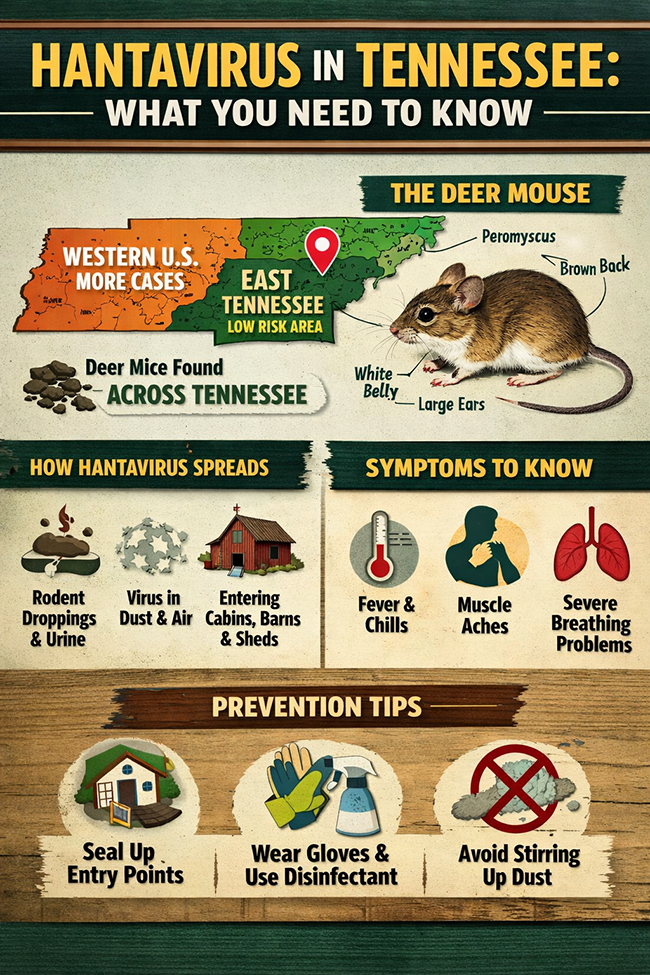 A rare but potentially deadly virus carried by common North American rodents has resurfaced in national public health discussions, prompting questions about local risk here in East Tennessee. While Hantavirus Pulmonary Syndrome (HPS) remains extremely uncommon in the eastern United States, the deer mouse—the primary carrier of the virus—is widespread across Tennessee, including the foothills and rural areas of Jefferson, Cocke, Sevier, and Hamblen counties.
Public health officials emphasize that the risk to the general public is low, but understanding the virus, its history, and how it spreads is essential for residents who live, work, or recreate in areas where rodent exposure is possible.
What Is Hantavirus?
Hantavirus is a family of viruses found in rodent populations worldwide. In the United States, the most serious illness it causes is Hantavirus Pulmonary Syndrome, a respiratory disease with a high fatality rate. Symptoms begin like the flu—fever, muscle aches, nausea—before rapidly progressing to severe breathing difficulty.
There is no person to person transmission documented in the United States. All known U.S. cases have been linked to rodent exposure.
How the Virus Spreads
The Centers for Disease Control and Prevention (CDC) states that humans become infected primarily by inhaling virus contaminated particles from rodent urine, droppings, or saliva. These particles can become airborne when:
- Sweeping or cleaning rodent infested areas
- Opening long closed buildings such as sheds, barns, or cabins
- Disturbing nesting materials
Less common routes include rodent bites or touching contaminated materials and then touching the eyes, nose, or mouth.
The virus can remain viable in the environment for several days, especially in cool, shaded areas.
The Deer Mouse: A Common Carrier in Tennessee
The deer mouse (Peromyscus maniculatus) is the primary reservoir for Sin Nombre virus, the hantavirus strain responsible for most U.S. cases. Deer mice are:
- Small, with brown backs and white bellies
- Extremely common in forests, fields, and rural structures
- Present throughout all of Tennessee, including East Tennessee
The U.S. Geological Survey and Tennessee Wildlife Resources Agency list deer mice as one of the most widespread small mammals in the state, thriving in wooded areas, farmland, and even residential outbuildings.
Although the virus is far more common in western states, the presence of deer mice means East Tennessee is not entirely risk free.
A Look Back: Hantavirus History in the U.S.
Hantavirus first gained national attention in 1993, when a cluster of unexplained respiratory deaths occurred in the Four Corners region of the Southwest. Scientists identified a new virus—Sin Nombre virus—and traced it to deer mice.
Since national tracking began:
- 890 laboratory confirmed cases of hantavirus disease have been reported in the United States (CDC, 2023).
- The majority occurred in New Mexico, Colorado, Arizona, and California.
- Less than 3% of cases have been reported east of the Mississippi River.
A published case report has documented a suspected hantavirus infection in East Tennessee, underscoring the need for awareness even in low incidence regions.
Why East Tennessee Residents Should Pay Attention
East Tennessee’s landscape—wooded ridges, farmland, lakeside cabins, and older outbuildings—creates ideal habitat for deer mice. Residents are more likely to encounter them when:
- Cleaning barns, sheds, or storage buildings
- Opening seasonal cabins
- Working in crawlspaces or attics
- Clearing brush or woodpiles
While the risk remains low, the consequences of infection are severe, making prevention essential.
How to Reduce Your Risk
Public health agencies recommend the following precautions:
- Do not sweep or vacuum dry droppings. Instead, spray with disinfectant, let sit, then wipe.
- Seal gaps and holes in homes and outbuildings to prevent rodent entry.
- Store food securely, including livestock feed.
- Use gloves when handling traps or cleaning rodent infested areas.
- Ventilate closed buildings for at least 30 minutes before entering.
These steps significantly reduce the chance of exposure.
The Bottom Line for Jefferson County
Hantavirus is rare, but the deer mouse—the virus’s primary carrier—is common in East Tennessee. Residents who work or live in rural settings should be aware of the virus, understand how it spreads, and take simple precautions when cleaning or entering rodent prone areas.
Public health officials stress that awareness, not alarm, is the appropriate response.
Sources:
- Centers for Disease Control and Prevention (CDC): Hantavirus Overview, Transmission, Case Data
https://www.cdc.gov/hantavirus - National Institutes of Health (NIH): Hantavirus Research and Virology
- U.S. Geological Survey (USGS): Deer Mouse Distribution and Ecology
- Tennessee Wildlife Resources Agency (TWRA): Small Mammal Species in Tennessee
- New England Journal of Medicine & Emerging Infectious Diseases: Peer reviewed studies on Sin Nombre virus and deer mouse transmission
- Case Report: Suspected Hantavirus Infection in East Tennessee (PubMed indexed clinical literature)